I’ve got a few things that I am looking into, however they are not quite ready. I have had one health setback after another, and this blog has suffered because of it.
Given the Trump Administration’s terrifying attitude toward Latin American refugees, I thought I’d refresh everyone regarding the Juarez murders. You can read about them here. I will add more informative links as I come across them.
So much of what has gone on in Latin America was either caused or exacerbated by conditions in the United States. It is cruel to stigmatize and punish refugees. Not only that, but our economy is going to suffer and it costs more to round up and deport refugees than to provide sanctuary.
I took a very long break, as you can see, but Cold Cases and Missing Persons has a special place in my heart, and while I have not been able to write for a long time due to some health setbacks, I am always saving clippings and files.
Last year, I sat down to cobble together my notes on the Wayne County murders and compose my thoughts, but my brain felt exhausted. I have been rehabbing from a foot and shoulder injury and am also on the mend from a heart condition. For various reasons, I have not been able to finish the story. However, I found another very interesting case and while I get my head back together to write another long piece, perhaps you might like to read this very good article about one of New Hampshire’s most famous missing persons case.
I was a teenager in the eighties, and I also recall that this was a time when parents were less guarded about where their teenagers wandered off to at night. Some of the things we did would seem crazy now in this age where teenagers grow up online. This article was so well researched and written that it had me hooked. For example, there is this chilling paragraph:
“After five months with no sign of Tippy, another article ran in the Concord monitor by a different author and the tone was quite different.
“It opened, ‘All the 156 Concord children who were reported to be missing or to have run away between Jan. 1 and Nov. 30 [of 1984] have been found – except one.”
That teenager was Tippy McBride. Shirley Ann McBride led a pretty interesting life for a teenager, the article describes her life with evocative detail. Investigators may or may not have a suspect, but as with many well-publicized cases, I personally do not find the facts aligning, but I will give it a closer look.
It has been quite a while since I posted here…I care very much about this project, and I still spend a lot of leisure time on true crime, but I became ill for quite some time again.
In February, I had a heart attack and spent six days total in the ICU. That set me back a few months. I am still trying to get my strength back. I had grand ambitions for this blog, and I am truly sorry that I have no been able to keep up.
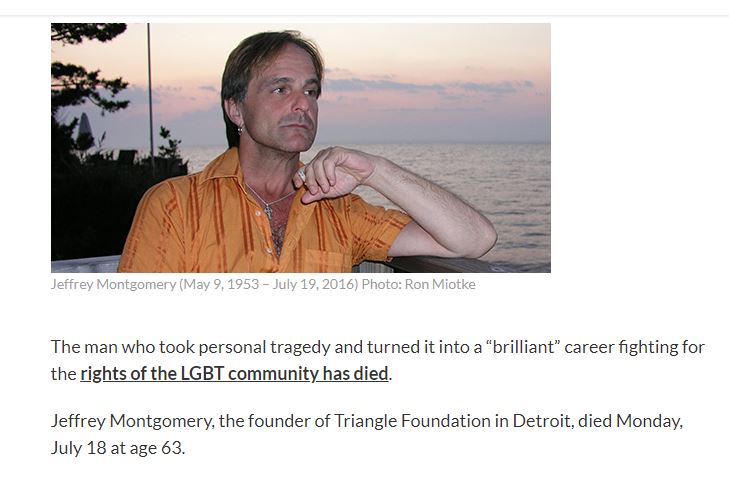
Anyhow, I keep going back to these murders of gay men in and around Detroit, and I found this news item from 2016:
Montgomery started a gay rights group in Detroit, the Triangle Foundation, to raise awareness about LGBT violence. But what spurred his activism was the shooting death outside a Detroit bar a man he was dating.
Montgomery was told by police that this was just “another gay murder” and that he shouldn’t expect warrants or arrests.
I just found it alarming how many “gay murders” there were in the Detroit area back then. I myself grew up in Calumet City, Illinois, home to a large number of gay bars, and even I don’t remember that many homicides of gay men.
I hope to type more about these murders, and further thoughts about the Traci murder and possible related murders in the next week or so. The story about the guys who may have done this murder is fascinating.
Quarantine has me finally catching up on my hobbies, including going through my collection of clippings. How I missed this 2014 article on the murder of Wayne State English professor Philip “Phil” Traci is beyond me. It’s exactly the sort of case I take an interest in. Phil Traci was a popular professor of English and Shakespeare expert at Wayne State University. Openly gay and extraverted, he held many gourmet dinners and parties at his home and gave out his home phone number at lectures. It was apparent that he had a vital social life and was well-liked.
Deborah Laura, then a law student at Wayne State, described her first college Shakespeare class with Traci: “… he didn’t have students — he had a following. … He felt that discussion was the only vehicle by which he could both teach and learn. … Each of us was made to feel as though we had something important to add to the class, so each of us did.”
On the morning of March 13, 1984, his friend Lorne Hanley was to meet Traci for a coffee date along with Hanley’s landlord, Bill Johnson. Johnson had called Traci’s house, and there was no answer, so they headed to the professor’s house, worried. Johnson had keys to the house, and after pounding on the doors and windows, the two let themselves inside. On the kitchen floor was Traci, who had been stabbed to death multiple times.
Thirty-six years later, almost no information regarding the murder of this highly regarded professor is available. When Monica Mercer of Hour Detroit requested the police file of Traci’s case, she was told that the Detroit Police Department could not locate it. One of the investigators in a similar case in which a gay educator was stabbed could not remember the name of that victim, let alone the name of Philip Traci.
“The joke was, if you needed a list of suspects in a gay homicide, just look in the phone book,” said the former detective, who asked for his name not to be used because of his current position in Oakland County. “It wasn’t that we didn’t try. It’s just that some of these victims were with different men every day. In any homicide if I got one usable fingerprint out of a thousand, I was lucky. It was high stress, and the reality is, it was hard to solve these types of crimes.”
That other victim, Northern High School librarian Ronald Hamilton, was also a gay man in his forties who lived alone. But most remarkable is the fact that Ronald Hamilton was also found stabbed to death in his home on the exact same morning. Both men’s pockets had been turned out. Hamilton lived four miles from Traci, and the two men had mutual friends. However, Traci was not mentioned at all in Hamilton’s case file. Although numerous Free Press articles about the homicides link the two, I could find no indication that police thought there was a single suspect in the murders. The owner of a car with vanity plates that had been in Traci’s driveway the night before had been tracked down. However, police were apparently unable to link Traci’s alleged visitor to the crime. In any case, Traci’s friend’s felt that police had not taken Traci’s murder seriously enough, perhaps privately attributing his death to his “lifestyle”. Yet the very similar homicide of Ronald Hamilton would indicate that a serial predator might be responsible – an extremely vicious one.
A detailed search of local newspaper archives, however, turned up one possibility regarding the deaths of these two men. On April 2 of the same year, the body of Detroit area high school teacher Richard Bryant, who was 58 years old, was found in his bathtub, having been stabbed 64 times. His throat had also been slashed. Bryant was also gay. However, this case resulted in an arrest and conviction – two, in fact. Two men who had recently been released from the Riverside Correctional Facility in Ionia, Michigan were found guilty of that crime. Those men were Clarence Ray, 28, and James Shultz, 21. The two had become friends while locked up.
A key prosecution witness, Emmy Thompson, a friend of Ray, testified that he had described the slaying to her and a former roommate April 2 at a Melvindale motel.
She said Ray told her that he and Schulz had picked up Bryan at the R n R Saloon, a Michigan Avenue bar frequented by homosexuals, and had gone with him to his apartment to rob him.
Schultz hit Bryant over the head with a bottle, and when Bryant started screaming, Schulz held a pillow over his face as Ray stabbed him, Thompson said Ray told her. The men ransacked the home, put Bryant’s body in the tub and left in his car. (Detroit Free Press, 12/06/1984)
The witness also testified in court that one of the men had a watch that had belonged to Bryant. Here we have three gay men – all well-regarded educators, all stabbed to death an outrageous number of times. Could Ray and Schulz be guilty in the murders of Traci and Hamilton?
(to be continued…)
For further reading on life for LGBT people in Michigan, check out this timeline from the University of Michigan.
Netflix has a new documentary series on Luka Magnotta, who videotaped his murder of Chinese immigrant and student Lin Jun.
You may and probably should watch this series (it’s short) for some background on the case. However, there is a better, more informative video available for free on the web, courtesy of The Fifth Estate:
In the Netflix video, a group of animal lovers dedicated to fighting animal abuse sought information about a video of a young man suffocating two kittens using plastic bags and a vacuum. The group did some good work, however I am astonished at how long it took for them to identify the perpetrator – 18 months, according the the Fifth Estate video. I hadn’t been familiar with the Magnotta case (I was suffering from a serious illness at the time and also taking care of a dying father), so as I was watching, I had no idea of who the kitten killer might be.
However, ten minutes into the Netflix video, I had already formed a profile in my mind: he was most likely North American and white, and very likely a white supremacist. I felt the display of narcissism and the attention-seeking nature of the kitten killing videos revealed someone with a political, however inchoate, motive. These animal folks were initially fooled by the numerous images and Facebook pages showing Magnotta’s alleged modeling career and world travels. Immediately I knew that this was a pathological narcissist who had created all of those profiles. Why didn’t someone on the Facebook group – which had thousands of members – take a criminal profiler’s approach to finding this guy?
Then there was the issue of the outlet – decent sleuthing for sure, as was the identification of the bedspread and vacuum cleaner. However, these issues could have also been resolved much more quickly if they had worked with the premise that the perpetrator was either from the United States or Canada. I find it hard to believe that they concluded that this outlet was not from North America. Here is what they saw:
First of all, it is impossible to tell what sort of outlet this is. Secondly, a brief look at Google Images shows a range of outlet styles in both the United States and North America. Seems to me that possibly looks large because it is one of the larger 4-plex electrical outlets?
The “find the kitten killer group” was enormous – it had thousands of subscribers (a really bad idea when you are certainly dealing with a sociopath and quite possibly someone capable of murder) and if you lack the requisite sang-froid, you’re very likely to get an adrenaline rush from the drama. Group dynamics on the internet tend to be unhealthy. Before you decide to hunt animal abusers, you ought to seek out alliances with trusted individuals. They should have not broadcast this information to such a large group.
The animal abuse crowd should have done a number of things first. For one thing, if you’re hunting animal abusers online, you must always assume that the animal abuser is either capable of or guilty of crimes against human beings. Do not separate violence toward animals from violence directed at individuals. That means that you should really think hard about why you’re online hunting or confronting predators, and you should probably have a strong grounding in criminology. You cannot just be an animal lover. Also, you should probably cultivate some relationships with people in law enforcement and criminal justice. The Fifth Estate video points out that police often don’t take internet crimes seriously – however, they should have done more research into finding law enforcement personnel who might take an interest in animal abuse? And I’m not sure if they bothered to alert the FBI and the Canadian Security Intelligence Service, especially after so many videos had appeared before the actual murder video.
If you’re going to engage in hunting predators or criminal profiling on the ‘net, you should be well-versed in the darker corners of social media. First of all, it would make sense to start a theory that you can test. The question ought not have been, “what sort of person would do this sick thing to a pair of kittens?” It should have been, “what message is this person trying to send to the general online population by publishing this video? And we’re clearly dealing with someone with a sick sense of humor, as indicated by the fact that he stroked the kittens before killing them, and then entitled it “one boy 2 kittens.” We’re dealing with someone with an enormous ego. Someone who wants to experience that power over so many internet users would most likely feel comfortable on platforms dominated by the English-speaking world – in particular, North America. He would also feel comfortable with such cesspools as 4Chan and 8Chan. Again, the psychology at work that I saw at play here was that of a privileged and vain white American, or possibly a Canadian. They should have started with that theory – which proved to be correct – right down to the white supremacist aspect, which Netflix did not cover at all – a negligent act on the part of the filmmakers. Anyone doing this should spend at least some time studying far-right hangouts and culture on the internet. The Pepe crowd loves engaging in lower levels of this sort of provocation – and their egos are fed in part due to their success in the very powerful North American world. I could have told you right off the bat that he was a racist, and that hunch was further confirmed by the vanity displayed and the obsession with achieving a very racist standard of physical perfection. Mass shooters, many of whom are racist or anti-Semites, very often exhibit similar characteristics. As the Fifth Estate video shows, Magnotta spent time on Stormfront and other white supremacist sites, and expressed a hatred for Chinese people. The Netflix documentary did not comment at all about the racist aspects of preying upon a shy and very vulnerable Asian immigrant.
If a situation like this happens again – and it quite possibly could – I hope that those trying to find a predator are more discreet and circumspect about what they do. There shouldn’t have been a panic that this individual could be anywhere on the globe. Occam’s Razor would have saved everyone a lot of time.
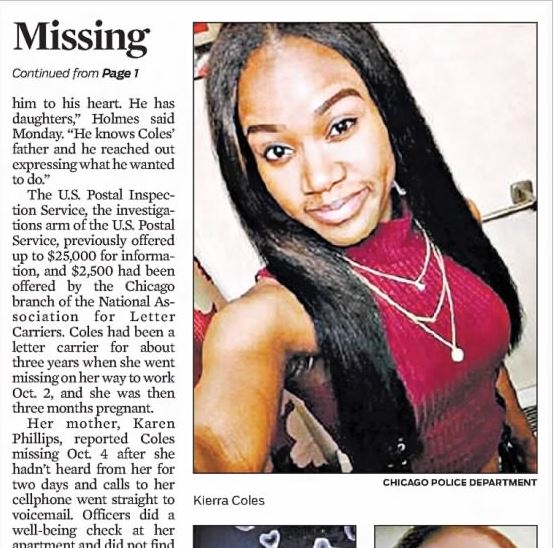
One missing black woman that is getting some attention is Kierra Coles. Kierra Coles is a postal service employee in the city of Chicago. She was last seen leaving home in her uniform, even though she had called in sick that day. Her car was parked in front of her home, with her cell phone inside. Kierra Coles was pregnant with her first child at the time of her disappearance.
According to NBC News in Chicago, police are focusing on a person of interest who is “an associate of hers”. Police suspect that Coles met with foul play. There is a substantial reward for information about this disappearance.
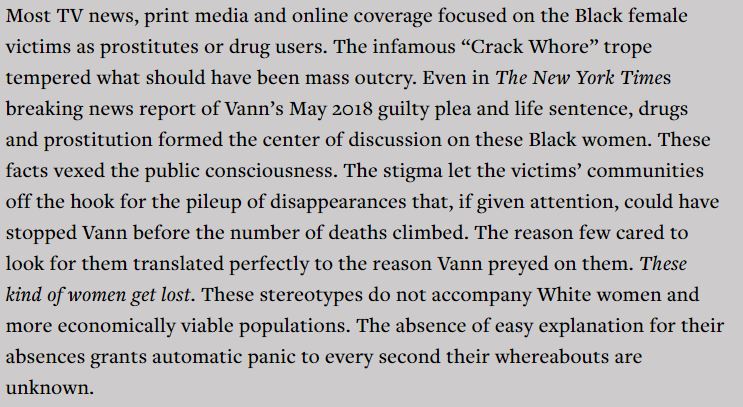
Kalisha Buckhanon has written a novel about a black woman’s search for her missing twin sister. All too often, missing people of color are not given the same attention as missing white people. When I collect files on missing persons and cold cases, I make an effort to pay attention to cases involving people of color. I was really pleased to read this interview in Sunday’s Chicago Tribune, in which the author talks about her own frustration in reading about cases involving missing black women.
In the interview, she lists a couple of resources that address the issue of missing black people. One is the Black and Missing Foundation. The other link is to an article written by Buckhanon for the site crimereads.com. This must-read article outlines the difficulties black communities and black women in danger face in seeking help, including a justified distrust of the police.
I know well the prejudices toward black and hispanic people who are missing, as well as those whose murders are unsolved. I live in a mixed race community, and from time to time, I encounter flyers that indicate a black resident of the community is missing. But if you comb the myriad missing persons databases, you’ll find that a large number of missing white people are likewise victims of the drug trade or are homeless or otherwise living on the fringes of society. The fact is, someone cared enough to report these people missing, and provide some background and a photo. Someone cared about them, and some predators are eluding accountability for their crimes. We owe it to them to give them the same attention we give missing white people.
Well, I broke down and got a subsription to Newspapers.com. Well worth it, not only for more in-depth information about cold cases, but also because it’s just fun to read an old newspaper. Money well-spent. I’m still trying to craft the perfect search for what I’m looking for.
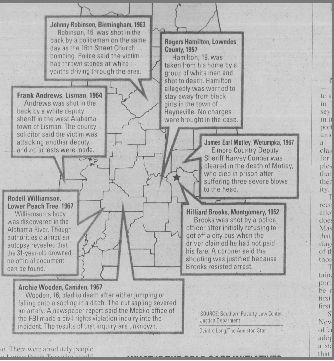
On my way to searching for another type of cold case, I found this article from the Anniston Star, 17 Feb 2008. It lists some cold civil rights cases from the 1960’s. At that time, the Justice Department had decided to take a fresh look at these cases.
For example, the case of Rogers Hamilton remains unsolved. In 1957, Rogers Hamilton, was ordered into a truck by a group of men who later shot him in the head. The Emmett Till Civil Rights Crimes Reauthorization Act of 2016 has expanded a law passed in 2007, which was when this graphic from the Anniston Star was published.
For further reading, see this article from three years ago from the Washington Post:
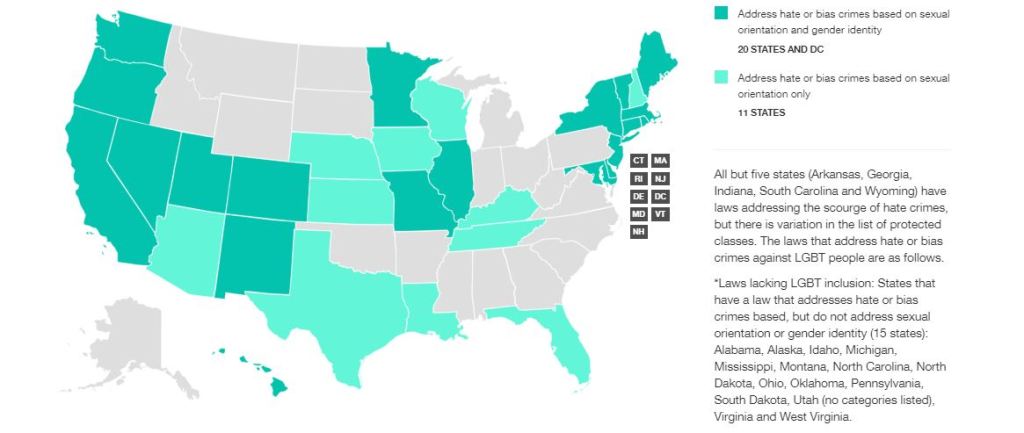
LGBT folk have come a long way…but not all states have hate crimes legislation specific to LGBT people. Here is a graphic to illustrate the current state of hate crimes laws in the United States:
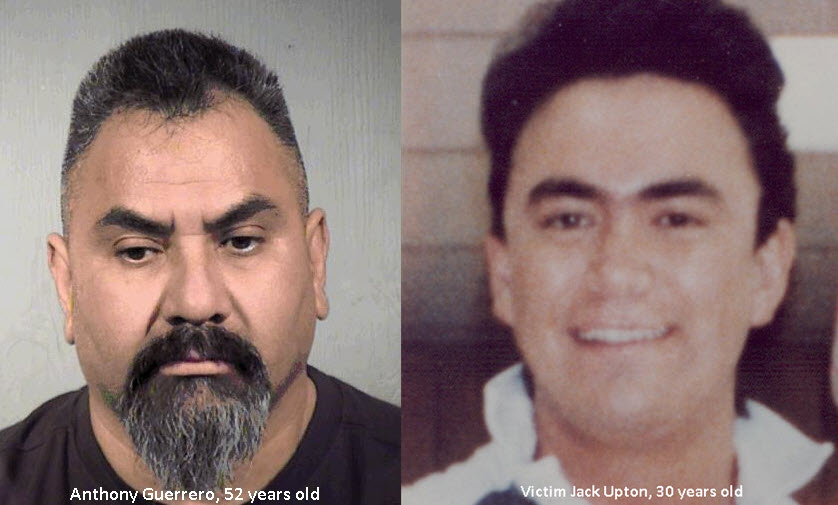
Earlier this year, Russell Guerrero of Chandler, Arizona was arrested for the 1990 murder of Jack Upton in Fremont, California. No motive has yet been determined for this disturbing and vicious murder of a well-liked and dependable Safeway manager.
He had been stabbed twenty times and had also been beaten and choked. His car had been stolen and found three hundred miles south of Fremont,
“
The DNA from the Upton case was processed and compared against existing genealogical DNA profiles which Parabon NanoLabs has access to and that search, along with other evidence, led to Guerrero as a potential suspect, police said.
Fremont Detective Mike Gebhardt said “the DNA blew us away” since Guerrero’s name had never come up before in the investigation, even with numerous interviews of people who knew Upton.
Police learned Guerrero was married and living in Tempe, Arizona. Fremont detectives went there, placed Guerrero under surveillance and were able to obtain a DNA sample from him for comparison. It was subsequently found to be a match from the blood found in the apartment and car, police said.
It ought to prove interesting to learn why this complete stranger murdered this apparently decent and responsible man for no reason.






 The Cold and Missing Persons Case Archivist